18 Feb 2012

Building up your emotional fitness (emotional resilience)

0 ප්‍රතිචාර
Stress is a part of everyday life. Stress has many sources of stress. Romantic breakdowns, friends changing, loosing a job, parent’s pressure, failing an exam and extraordinary events like deaths, serious illnesses and natural disasters etc can occur without a warning. People easily become frustrated by the pressures created that transform into stress that make you wear out. Here are few tips to improve your emotional fitness.


1. Talk to someone
Communication with someone help you express your innermost feelings and relief the tension rather than keeping it inside. You have to be careful who you are talking to. It should only be someone who you trust and someone has a interest at heart for you. Start with small things that make your sad, end up laughing about difficult experiences. It will help you improve your relationships and to connect with people.


2. Improve your self-esteem
Your self-esteem is the way you feel about yourself. Many things can cause drop your self-esteem. Romantic break-ups, not getting something you wanted or failing in something. Nothing can make you less worth, although you may feel so.
One way to improve your self-esteem is to treat yourself as your best valued friend. Value yourself as your best friend; be honest and never let down your best friend. Think bright side of yours not negatives. What you can do other's can't is your value.


3. Manage your stress levels
You may have lots of stress in your lifestyle. Exams, Schools, Teachers, Parents, Friends and Society may put pressure on you. With a stressed state of mind, it makes it easier for you to overreact or feel negative compared to someone who is relaxed. Managing stress is a gradual process. First look at your lifestyle. Are you involved in lots of activities? Genuinely ask your parents, teachers, partners and friends to help you to reduce work load. Take relaxing activities like yoga, photography and listening to music. Change your working hours. Do regular exercises. Do Breathing exercises for stress.


4. Enjoy yourself
Enjoying yourself is important for emotional health. Watch sports and go picnics with friends. Having a cup of tea with a friend can improve your day. Do something you are good at, such as cooking, singing, dancing, making something or helping someone. Try to achieve something of what you do. It’s better to avoid things that make you feel worse afterwards, such as alcohol.


5. Choose a well-balanced diet
You need to make healthy choices about your diet that can make you feel emotionally stronger. Read about healthy eating.


6. Do exercise
Even little exercise releases chemicals in your brain that lift your mood. It can help you to sleep better, have more energy and keep your heart healthy. 


7. Get enough sleep
Make sure you sleep seven to eight hours in average to make your body and mind to rest fully. 


8. Develop good relationships
Think about each relationship you have with family, friends and your partner. Are you really happy when you are with them? Do they have best interests at heart about you? Do they enjoy their company? Are you happy with the way they act towards you? Start to think about how you can improve your relationships, and then make little changes. You could even drop relationships if it does not really works out.


9. Know the warning signs
Try to recognize when negative emotions start creeping in, whether it’s stress, anxiety or feeling sad. Don't let them take over your mind. Start doing things that help you overcome them. Take a day off, go somewhere, talk to someone or just relax and have a good sleep.


10. Plan your work
Lots of people work without a proper plan for life. Ask yourself; what you would be doing tomorrow, next week, next month, next three months, next year, next three years, next 10 years. What will help you achieve them? What will not? What will you need to be there? Be realistic and Practical try to achieve what you can. 


11. Keep your mind healthy
Negative thinking of your self as well as about others makes your mind ill. Do not plan to hurt someone. Don't think about things someone has done wrong to you. Anything you plan to hurt another person will come back to you as an echo. Avoid negative things, negative activities and negative people. They always bring trouble even they seem so close.


12. Help others in problems
Helping others in their problems will help you understand nature of problems they face. One day it could be yours. The most voluble help you can do is asking whether they need a help. Listening is a good help to anyone. Help disabled people, elders or anyone in trouble. But don't make the problem yours or act as it's yours.
13. Connect With the nature
Plant a tree. Pour water to flowers. Take a walk in environment. Take a photograph of nature and post it online. Enjoy wind, breeze, rain and greenness by taking a trip.


Do you have the Resilient Attitude


Emotionally resilient people are more effective at managing stress as they have a specific set of attitudes concerning themselves and their role in the society. These attitudes help them to cope with issues and problems than their non-resilient peers.


The emotionally resilient people tend to:


  • Have realistic and attainable expectations and goals.
  • Show good judgment and problem-solving skills.
  • Be persistent and determined.
  • Be responsible and thoughtful rather than impulsive.
  • Be effective communicators with good people skills.
  • Learn from past experience so as to not repeat mistakes.
  • Be caring how others around them are feeling.
  • Caring about the welfare of others in society.
  • Feel good about themselves as a person.
  • Feel like they are in control of their lives.
  • Be optimistic rather than pessimistic.


11 Feb 2012

The new teaching model of the world

0 ප්‍රතිචාර
The new teaching model of the world incorporates problem based learning, project-based learning and challenge based learning focusing on real problems faced in the real world . It engages students’ curiosity and desire to learn to solve of real problems at the center of the curriculum, and giving students access to 21st century tools, help them to work collaboratively on their own time . In 21st century learning students direct the course of their learning and engage teachers in a supportive role as guides .


Challenge-based learning brings relevance to class work . It gives students the opportunity to focus on a challenge of global significance, yet apply themselves to developing local solutions, challenge-based learning creates a space where students can direct their own research into real-world matters and think critically about how to apply what they learn . It increases their engagement, time spent in learning, creative application of technology, and increases student satisfaction with education . And students master the subject-area of content and developed many of the skills identified as vital for 21st century learners.


in problem-based learning, the teacher’s primary role shifts from dispensing information to guiding the construction of knowledge by his or her students around an initially ill-defined problem . Students refine the problem, develop research questions, investigate the topic using a wide variety of primary source material,
and work out a variety of possible solutions before identifying the most reasonable one . Documentation of the process and a high-quality production of findings further serve to give the process relevance to the world of actual work .

29 Aug 2011

Telecentres for Innovating Youth Education for 21st Century

0 ප්‍රතිචාර
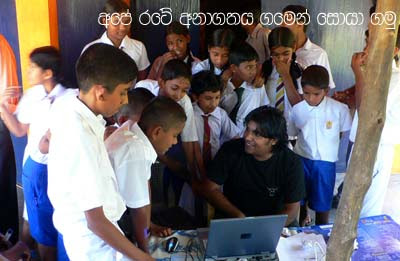
The mixed experiences of last 5 Years of engagement of rural education development through Nenasala telecentres has thought me that success of ICT4D depends on dedicated and committed people more than resources or market opportunities. The development of education brings impact directly in the lives of people as evident from Lahugala Nenasala Telecentre located in South east part of Sri Lanka which helped changing the shape of education in their village through Shilpa Sayura.


They wrote to me,


This poem means that

"Shilpa Sayura is the rain came on a dry land faced with the draught"


these words gives us an insights of value we can create through ICT in their lives.
Last decade we had been using ICT as a tool in education, now we find that ICT as a foundation which can be used to build future perspectives that removes disparities to access to national education. It’s clear that every nation in the world will continue to compete in a global economy that demands innovation. In this race where ever in the world poor people are like one nation without access to education.

In an era people are talking of radical re-generation of education, the context of delivery is as important as content. Hence we see Telecentres has a great potential to play a major role in 21st Century national education delivery by thinking beyond informal role played in development. This is demonstrated by Telecentres who changed the shape of the education in their villages using Shilpa Sayura, and become sustainable as a result even without connectivity.

People often say that future can't be predicted as it has more parameters than any scientific equation. Yet we have known that experienced human minds can process complex equations to develop novel ideas for the future. Shilpa Sayura as an ICT4D initiative explored formal education delivery through Telecentres and seems to have found a solution to develop rural education for 21st Century and also for sustaining of telecentres engaging them in mainstream national education development process.

Niranjan Meegammana
Shilpa Sayura Foundation


24 Jul 2011

ICT for Innovating Youth Education for 21st Century Skills

0 ප්‍රතිචාර

The society we live today was unimaginable 10 Years before. It’s not just examples of facebook, YouTube or mobile phones in every hand. Its the ICT innovations that changed the world. In 1970s we had little Tuition for weak students. It started to grow in 1980s, grew big in 90s and today Tuition has become a defacto where bright students takes most tuition. Societies Innovate when competition and resource limitations are faced. In World Telecentres appeared in 1990s, bubbled in 2005s now we see sustainable Telecentres growing in the in mainstream.

In the ICT4D arena many ideas have been bloomed. Some managed to become mature taking path finding approaches. ICT4D journeys which acquired mixed experiences. Some excelled, some got tired and vanished. The ones which matured, got kept moving, along the vision using the lessons learned from experiences to get further. All the insights may not be fore-sights, but one idea to be successful, it may be worth testing several. Then ICT for sights are become global examples.

From the experiences we understand that future can't be predicted. Future has more parameters than any scientific equation. Yet experienced human minds can process such complex equations to imagine shape of the things to come. Those who can build such scenarios will create novel ideas that would be paid back in future. They will excel when the time comes. Arthur C. Clarke imagined the shape of the new communication, he wrote it and others followed.

Last decade many developing countries had been focusing in using ICT as a tool to develop the society. When we look at experiences gained in a learned perspective, we will find that ICT is more than a tool, but a foundation which can be used to build futures. especially In the area of education, ICT has helped the word to progress much by connecting schools, introducing online education, setting up distance vocational training facilities, and introducing of ICT in to main stream curriculum. Where will we go from here in innovating education?

It’s clear that tomorrow’s world will test youth for 21st century readiness. Every nation will continue to compete in a global economy that demands innovation. As we are learning today's global education approaches seen as outdated and obsolete. People are talking of radical re-generation of education. Educators are more thinking what is more important in education? Whether it’s memorizing of the prime god of Mesapothemia ? or knowing why Messapothemia was demised? The latter knowledge will help a person and world in the efforts for survival?

Hence educators in the world over re-thinking of changing education paradigms to make education more contributing to innovation. Educators are thinking along new perspectives like four Cs, which is an education concept gaining high recognition in developed countries.

The four Cs are
  • 1. Critical thinking and Problem solving

  • 2. Communication

  • 3. Collaboration

  • 4. Creativity and innovation.
In United States leading schools are already following this idea by aligning education curriculum to 4Cs. Looking at 4Cs we can immediately tell that 4Cs are about new media skills like internet, social networks that have become dominant in shaping world. Hence ICT is a core 21st Century skill to align 4Cs for the educational curriculum. We need to train every youth to use ICT to solve problems effectively, and to communicate locally and globally using creative media, and collaborate with others for innovation. If the concept of knowledge society to become real, we need to find new ways to deliver knowledge to people more creatively, more efficiently using new channels like social networks and mobiles.

In time to come, nations will be measured how innovative they would be and what new knowledge they process and how they communicate such knowledge and collaborate creating solutions to problems. If we are to develop our youth to take 21st century challenges and win, we need to make them more innovative. We know that, Innovation is an output of creativity which can be enabled by ICT. Hence skills of using ICT for creativity matters as much as ICT literacy for daily life.

Adobe Youth Voices Program designed to supports young people to use of cutting-edge multimedia tools to communicate and share their ideas, demonstrate their potential, and create a positive social impact in where they live. In this initiative 2 educators were trained from Sri Lanka. Following is one of the creations of Adobe educator from Sri Lanka. Adobe Youth Voices Program will be initiated in Sri Lanka in 5 Schools, 3 Telecentres, a disabled school and a orphanage to train 100+ Youth and expand further to train creative media educators and youth more next year.

This media peice was created during Adobe Youth Voices Training conducted by Thinking IT Global 2011. This experimental video done as a digital story involved writing a poem, creating a story board, field photography, photo editing and video editing process, used a nikon professional camera, photoshop elements 9, premiere elements 9 and audacity software. The whole production was done in electronic medium including exhibition.

Niranjan Meegammana
Adobe Youth Voices - Educator
http://www.shilpaayura.org